A NEW REPORT from the CTA Institute for Teaching and the Economic Policy Institute shows that increasing public education funding results in huge economic and social returns for California and the United States.
“Investing in California’s Public Education: The Path to Equitable Reform” examines the research on how universal public education is a necessary condition for steady and broadly based economic growth; high public investment in education yields high social returns. In other words, the benefit of investment in all students and all schools is an educated, thriving workforce and equitable, stable society.
“When a child gets a great education, the benefits ripple out into their family, community and the workforce,” said Hilary Wething, EPI economist and report co-lead, at the August press conference announcing the new report. “It also ripples out into lower crime rates, a stronger tax base, and into a more capable and creative economy for everyone.
“Rigorous research has shown repeatedly that additional investment in public education produces social gains, such as higher educational attainment and greater lifetime success.”
In addition to examining prior academic research and analyzing state policies, researchers interviewed teachers, paraprofessionals, superintendents, school administrators and youth advocacy groups throughout California. They also asked students to show what fully funded schools would look like for them.
The report also identified challenges and obstacles to California’s ongoing investment in education, and found that permanent reforms that facilitate increased and sustained funding have led to large and measurable gains to student achievement and success.
California has the highest cost of living of any state in the U.S. but ranks 36th in per-pupil education spending.
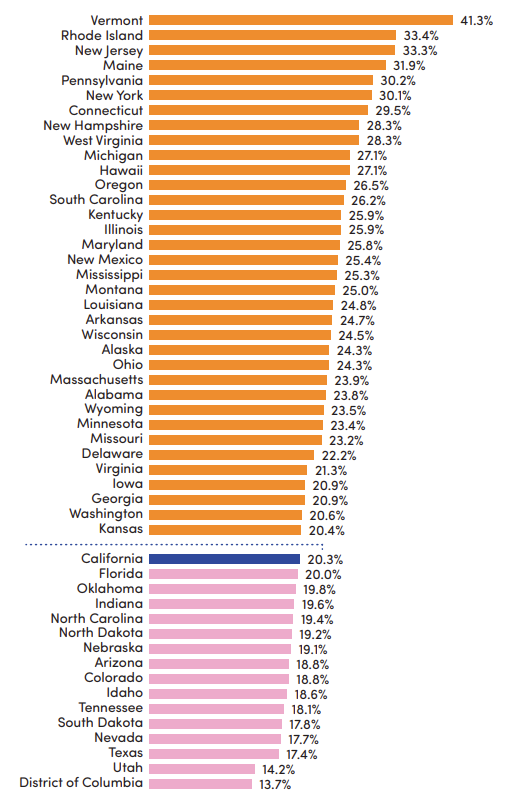
California’s education spending per pupil as a share of per-capita GDP in 2022 was low relative to its capacity. California only spends about 20% of its GDP-per-capita on education, whereas other high cost, densely populated states like New York spend nearly 30%.
Decades of disinvestment
The report outlines several major issues that have affected how California has funded public education over the years. Despite currently boasting the fourth-largest economy in the world, California ranks 36th in the nation in per-pupil funding. California spends only about 20% of its Gross Domestic Product (GDP) per capita on education. Comparatively, 35 other states spend more on education relative to GDP.
“It’s baffling that in California we’re still fighting to stabilize the unequal, volatile system of how schools are funded, when our state has more than $4 trillion GDP and when CA corporations received $94 billion in tax breaks the last year alone,” said CTA President David Goldberg at the press conference.
The result of chronic underfunding, as educators know all too well, are under-resourced, understaffed schools, inadequate facilities, crowded classrooms, and more. California has one of the highest student-to-teacher ratios in the country, nearly 22:1, against a national average of 15:1.
Even with collective bargaining rights, California public school teachers still make significantly less than peers in their state with similar education and credentials.
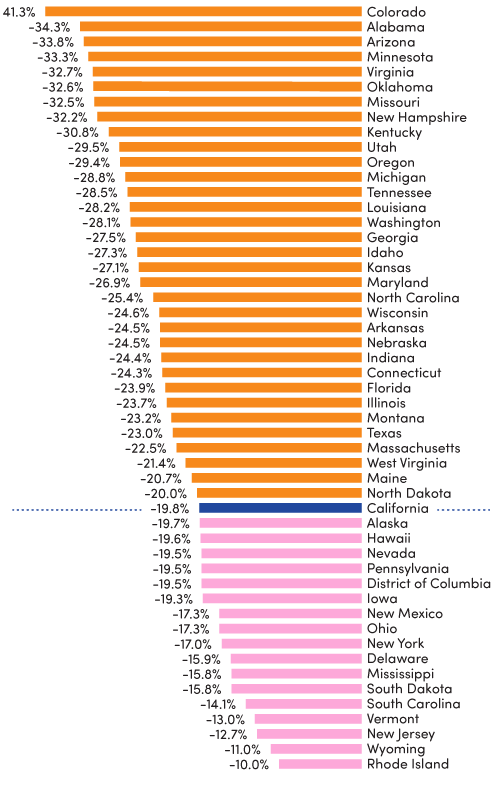
How California’s teacher pay gap compares with other states: State-specific regression-adjusted weekly wage penalties for public school teachers relative to their college-educated, non-teaching peers.
“It’s not reasonable to expect educators to pay for supplies with their own money, work unpaid overtime, or take on responsibilities previously done by professionals in eliminated positions,” said Elena Villa, a 26-year veteran educator and Redlands Teachers Assn. member who teaches high school performing arts. (Villa spoke at the press conference; students at her school worked with researchers on the report.)
“Professionally, I am exhausted, but we do this work because we want to create robust programs that are a norm and not the exception, so our students and communities can understand what’s possible when a school looks fully funded.”
And while many California educators have recently seen wage increases after organizing locally and in some areas going on strike to improve working and learning environments, teachers still face a huge pay penalty in the Golden State.
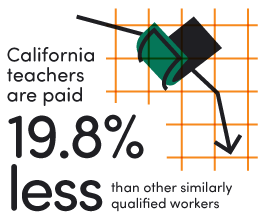
“California’s nominal teacher pay looks decent on paper until you account for the fact that California is the single most expensive state in the country to live in,” Wething said. “Once you adjust for that and compare California teachers to similarly credentialed workers in other fields, California teachers are paid nearly 20% less.”
A path to permanent reform
The report acknowledges that the policy reforms and progressive tax initiatives in the 2010s notably changed the trajectory of investment in California public education for the better; in fact, spending reforms have pushed the progressivity of California school financing — how much relative spending goes to higher poverty districts — near the top of national rankings. But the report points out that the state still remains in the bottom third of public education investment effort nationwide.
The report charts a path to a future where state education funding is robust and student success is near-universal. These include many measures — such as reforms to the state’s corporate income tax — that could provide significant revenue and should be pursued. Any measure that boosts the state General Fund would strongly benefit public education financing.
Wething states that taking specific actions now are essential:
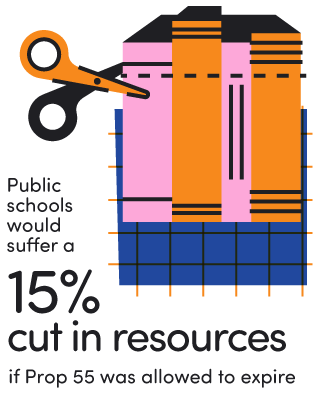
• Pass Prop. 3 in November to make existing taxes permanent and boost overall revenue for public school funding. If Prop. 3 fails, education funding will be cut by 15%, one in six educators could lose their jobs, programs and resources would be severely curtailed and students and communities would suffer the consequences for years.
• Protect against funding threats from the federal government. Pandemic-era federal aid has dried up, and the Trump administration is threatening to withdraw federal contributions to education, which make up 14% of education funding in California and has been targeted at special education and high-poverty districts. Cuts to Medicaid and SNAP will strip away resources that keep children healthy and fed.
• Increase the LCFF base grant; reform Prop. 98 to further grow the general fund, and reform Prop. 13 — particularly the treatment of commercial property. Both would grow monies that flow into the LCFF grant pool.
The report concludes that choices made by California voters and policymakers in the past decade have made improvements to the level and equitable distribution of school funding, but there is scope to increase these dividends for future generations by building on these reforms and redoubling efforts to fully fund all of the state’s public schools.
To read “Investing in California’s Public Education: The Path to Equitable Reform,” visit bit.ly/IFT_EPI_report2026.

To learn more about Prop. 3 and get involved, read the related stories on pages 18 and 22, and visit
cta.org/YesOn3.
Our history provides a roadmap for change
UNIVERSAL PUBLIC EDUCATION was the primary reason why the United States became the richest economy in the world in the 20th century. Yet recent decades have seen the public investment effort put into K–12 education in the U.S. lag across many measures. California specifically made huge investments in public education in the mid-20th century but then let anti-tax politics severely compromise this investment.
The Local Control Funding Formula (LCFF) reform of 2013 — along with Propositions 30 and 55, two voter-approved progressive income tax measures CTA members organized to win — brought time-limited increases in overall education spending levels to California. Gains to student achievement and success have been large and measurable as a result. Further reforms could lock in and expand on these gains, including making permanent the revenue increases provided by Props. 30 and 55.
Major legislation and events in state education funding:
• 1978: Prop. 13 passes, which limited property tax revenue collected from long-term homeowners and corporations; it decimated a stable source of state revenues to spend on education. Before 1978, property taxes provided about 60% of K–12 education funding in California, but after passage of Prop. 13, that percentage dropped to 30–35%. (The rest comes from income and sales taxes.)
• 1988: Prop. 98 passes, an effort to stabilize education funding; it set a minimum guarantee of state funding yearly — typically 40% — of state general fund revenues for K–12 schools and community colleges. The problem, as noted in the report, is that the state has considered 40% to be the ceiling rather than the floor, and funding decreases when the budget faces a shortfall.
• 2012: Prop. 30, backed by CTA members, passes, which raises sales taxes slightly and enacts significant revenue increases from the richest California households for the general fund and health care programs.
• 2013: The Local Control Funding Formula (LCFF) is a policy reform that shifts spending control to local districts and provides extra money for high-needs students and districts. Prop. 30 revenues complement the LCFF; the combination of both policy changes increases the level and progressivity of public spending on education. As underscored in the report, results have been unambiguously successful: An additional $1,000 in per-pupil LCFF spending sustained over three years produced a full grade level of improvement in math and reading.
2016: Prop. 55 passes after CTA members organized to win; the measure extends the Prop. 30 income tax hikes, which were scheduled to expire in 2018 and will now expire in 2030.
• 2026: Prop. 3 is currently on the November ballot, driven by the work of educators around the state, and seeks to make existing income tax hikes on wealthy Californians permanent.
“With Prop. 30 in 2012, we took decisive action and generated revenue through a set of time-limited sales and personal income taxes,” said Goldberg. “Then we did Prop. 55 in 2016, and that extended Prop. 30 taxes.
“And now [we have] Prop. 3 in 2026, which will permanently safeguard and extend revenue generated by Props. 30 and 55.”
The Discussion 0 comments Post a Comment