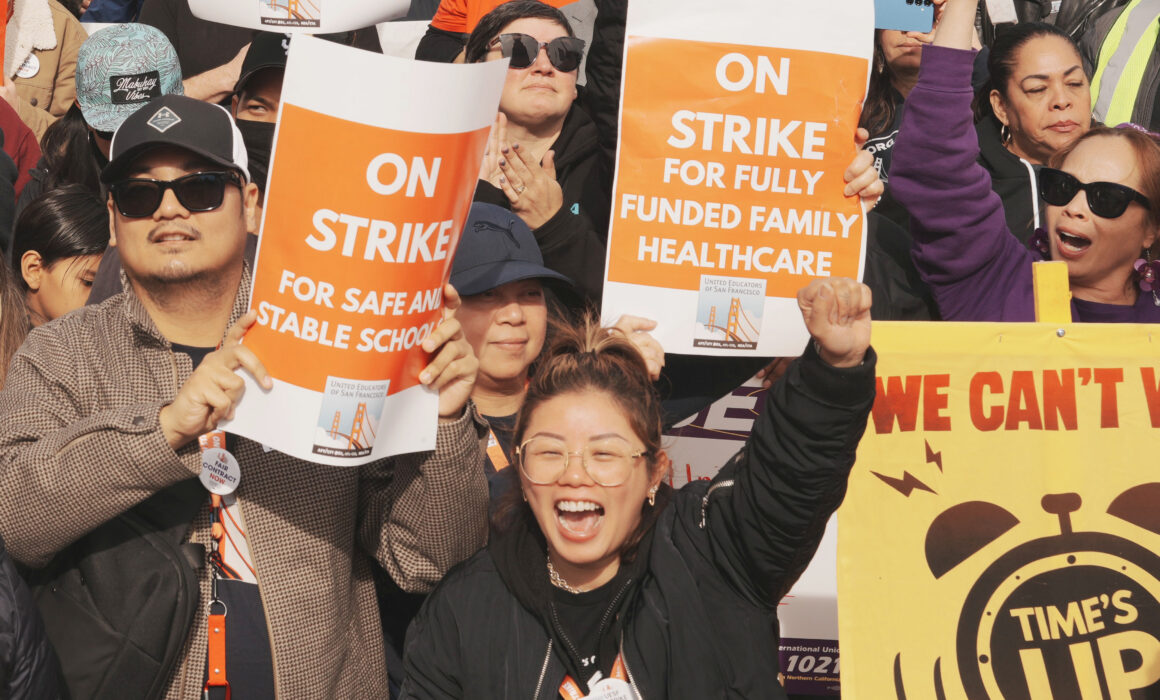
“YOU ALWAYS HEAR other locals are fighting for similar things but being a part of the We Can’t Wait campaign, we saw it’s really true,” says Brittoni Ward, president of Twin Rivers United Educators (TRUE). “We were all fighting for our own contracts, but the common thread was health benefits. So many of us are suffering from these high-cost plans where the district isn’t putting enough in. I really do think we started a wave here and all our CTA siblings can see they can win this for themselves, too.”
When the campaign kicked off last February, the fight for safe, stable and fully staffed public schools included a demand for competitive wages and benefits. And with chronically skyrocketing out-of-pocket costs and the failure of educator pay to keep up with inflation, the issue emerged as a centerpiece of our union’s major local fights last school year.
In chapters across the state, increasing monthly premiums without similar bumps in pay or school district contributions to health care have been creating unsustainable conditions for some educators who have seen their costs balloon to more than $2,200 a month to ensure their families have coverage. This is causing major churn in school districts with the highest impacts to educators — even causing many to consider leaving education altogether.
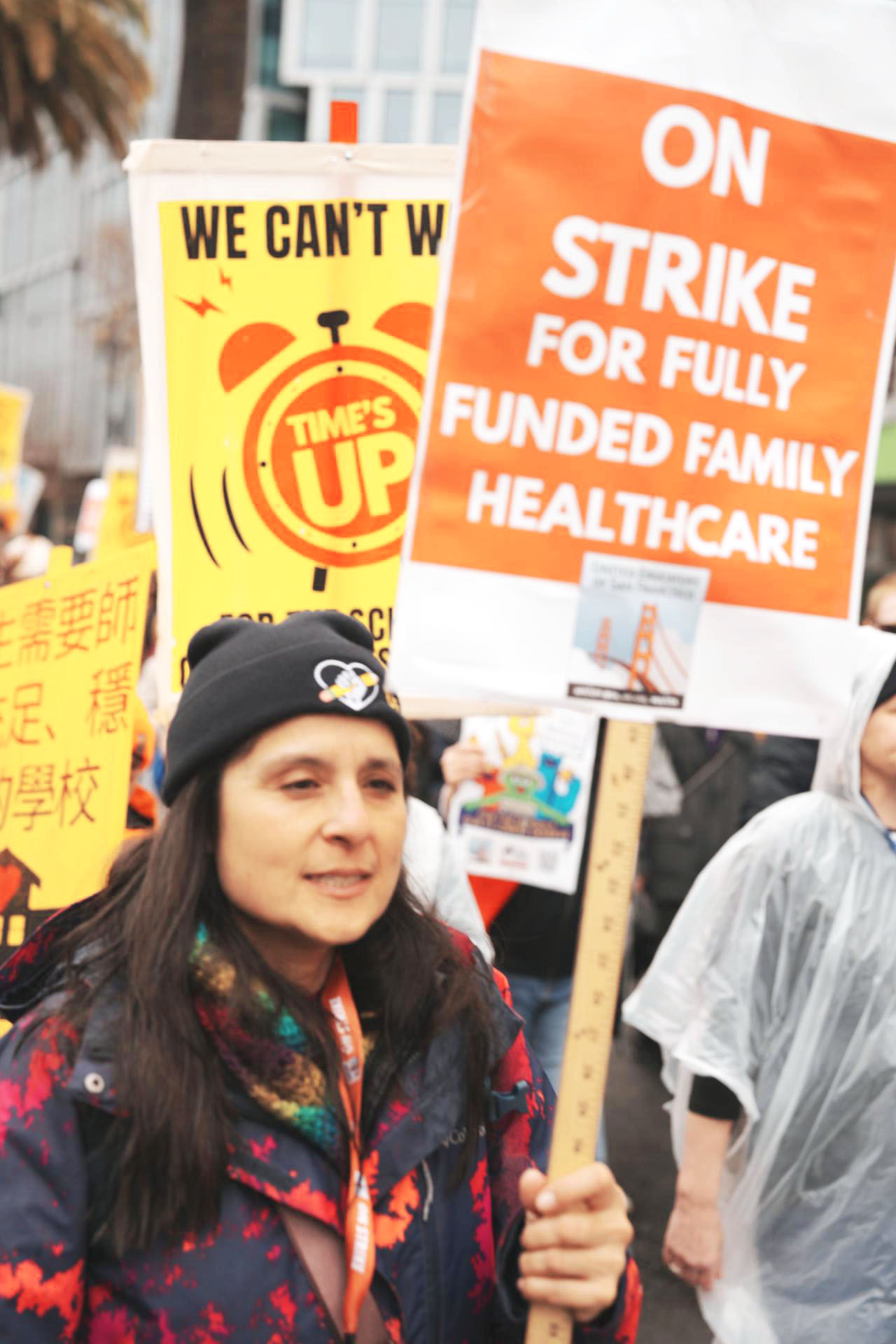 The pushback and demand for health care benefits was central to campaigns in local chapters including United Teachers of Richmond (UTR), who paved the way with their historic strike victories late last year, TRUE and Natomas Teachers Association (NTA), who were committed to striking to win better benefits, and West Sacramento Teachers Association (WSTA) who secured major improvements because they were also prepared to strike. Their district even admitted to feeling pressure to avoid a strike like neighboring districts in the Sacramento region.
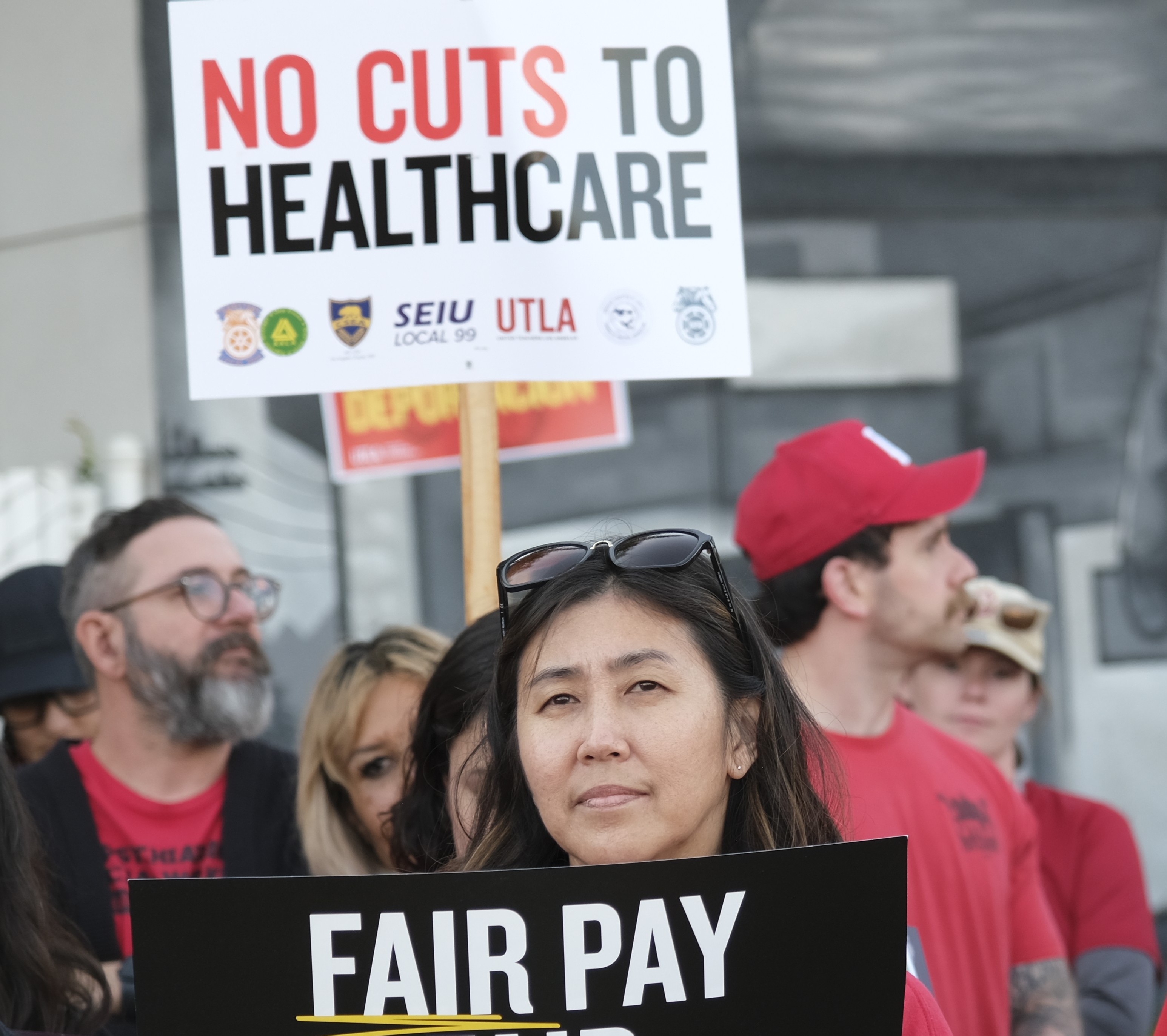
Educators across the state are demanding fully funded family health care; at left, UESF educators on strike, and at right, a UTLA rally in late 2025.
“The fight for health care and other issues look different in every district but the common theme is we were all fighting for affordability,” says NTA President Nico Vaccaro. “Going on strike was tough but when we saw other people going on strike and winning, it really gave us the inspiration that we weren’t going it alone.”
WSTA President Doug Knepp says the fight of neighboring locals TRUE and NTA absolutely contributed to WSTA’s tentative agreement while his local chapter were preparing to strike. He says this year’s success shows that we can no longer accept excuses from ineffective politicians and that the path to the public schools our students deserve
is through organizing and action.
“School districts love to triage problems so they take the burden off of state politicians. When we use duct tape and Bandaids to hold a broken system together, we are not able to hold our leaders accountable to fix the system.” Knepp says. “This system is broken and by pretending it’s not, it’s perpetuating this endless cycle of undervaluing the education of our children in this country.”
Starting Off Strong: Richmond Teachers Set the Standard
United Teachers of Richmond (UTR) President Francisco Ortiz says educators in West Contra Costa Unified School District previously had fully paid health care benefits but lost them in a bargain some time ago. After UTR’s proposal in their previous bargain was summarily rejected, Ortiz says he knew it was a priority for this year’s contract campaign.
“I was confident that we would be successful because we had built the structures and I knew our members would come and show out,” Ortiz says. “Fighting back for something we had and restoring it, especially with the increased cost of health care, is a huge win for us because that’s going to be money in people’s pockets.”
Through the power of their five-day strike in December 2025, UTR won fully paid benefits for educators and their families by mid-2027 — helping to stem chronic churn that has seen teachers leave WCCUSD for districts that provide better benefits. Ortiz credits strong site-based organizing, brutal honesty and clear transparency with members for their success.
“The most important key was relentlessly saying what we were going to do and doing what we said — it might sound cliché but that’s what it really is,” Ortiz says.
Leading the first of six strikes by CTA locals this year, Ortiz says he appreciated joining locals’ picket lines in Sacramento and Dublin to support and help keep the momentum going for the fight for fully paid health care.
“Lead with hope, believe in your members and trust in the process,” he says. “Claim or reclaim your organizer voice — we’re all organizers and we can’t be afraid to change things!”
Historic Strike in San Francisco for Health Care Equity
For the first time since the union’s founding in 1919, all United Educators of San Francisco members will have fully paid health care benefits, following their win secured through their four-day strike earlier this year. Their victory addresses ongoing increases in dependent health care costs for UESF members, which were eating up negotiated raises for educators with families and inequitably impacting paraeducators, some of whom were paying as much as $1,600 a month for health insurance for their families.
“For some of our paras, that was a majority of their paycheck,” says UESF President Cassondra Curiel. “We knew we had to go after dependent health care so that any pay increase we won would be felt across the entire unit.”
As part of their win, all health care premiums for dependent health care coverage will be decreased by 50% at the start of the 2027 school year — and in January, they will be completely covered. Curiel says this victory will impact UESF members in substantial ways, sharing that two married members of the bargaining team said they might now be able to afford to have a child.
“No matter the circumstances, UESF members will now be able to use their full paycheck to take on the challenges we all are under,” Curiel says. “That is the most winning measure of this contract campaign.”
Curiel says strong site structures were a big part of UESF’s success at the table and on strike — with the local making a deliberate effort to establish a union-building committee at every school site to create teams and split responsibilities to pull off the actions needed at each to win collectively. A local rooted in transparency, UESF’s bargaining and leadership teams provided consistent communication along the way by email and video to allow members to access the level of information best for them. Curiel says UESF embraced organizer Jane McAlevey’s approach to internal communications and achieving their goals.
“The level of understanding is equal to the level of participation and the level of participation is equal to the level of understanding,” Curiel paraphrases.
This past year of educator struggle and triumph has been special, Curiel says, especially as part of the greater We Can’t Wait campaign, joining locals across the state to create new, better standards for our public schools and students. Likening it to worker wins like the 40-hour work week and child labor laws, Curiel says We Can’t Wait is an example of what we are capable of together even in these challenging times.
“For every inch we push on our own, we move leaps and bounds collectively — we’re pushing a lot further than on our own, trying to claw back what should have been here the whole time,” Curiel says, noting that the local fights are having statewide impacts. “As a result of this year-long We Can’t Wait crusade we’ve been on, the governor’s revised budget proposal is putting more resources into education — the amount of force from our school communities putting pressure on the state for more funding is making a real difference!”
Springtime Solidarity as Educators Fight for Health Care
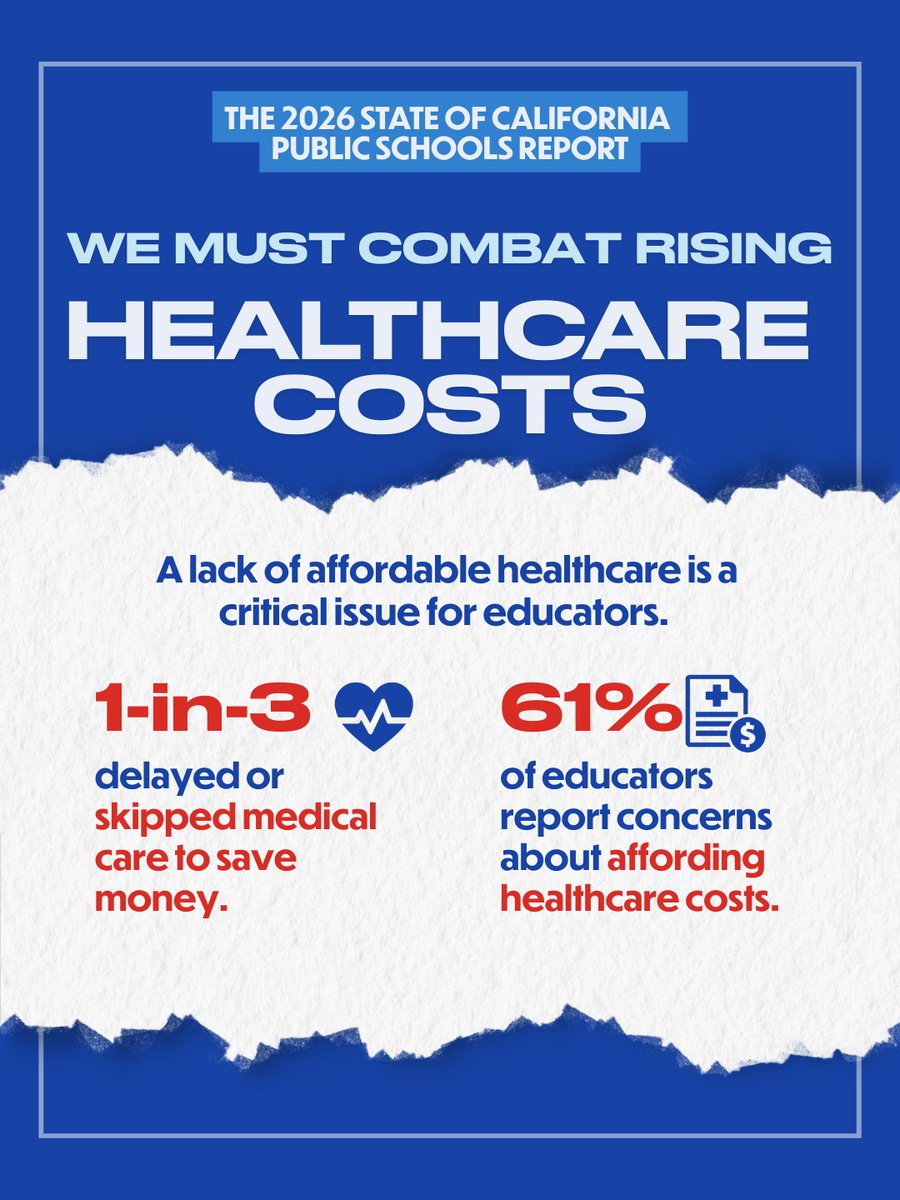
Below: Our union’s 2026 report, “The State of California Public Schools,” surveyed 2,000 of our TK–12 educator members and found that they consider health care to be a major issue — and that they are willing to strike to lower health care costs. See the full report at
cta.org/document/the-state-of-ca-public-schools.
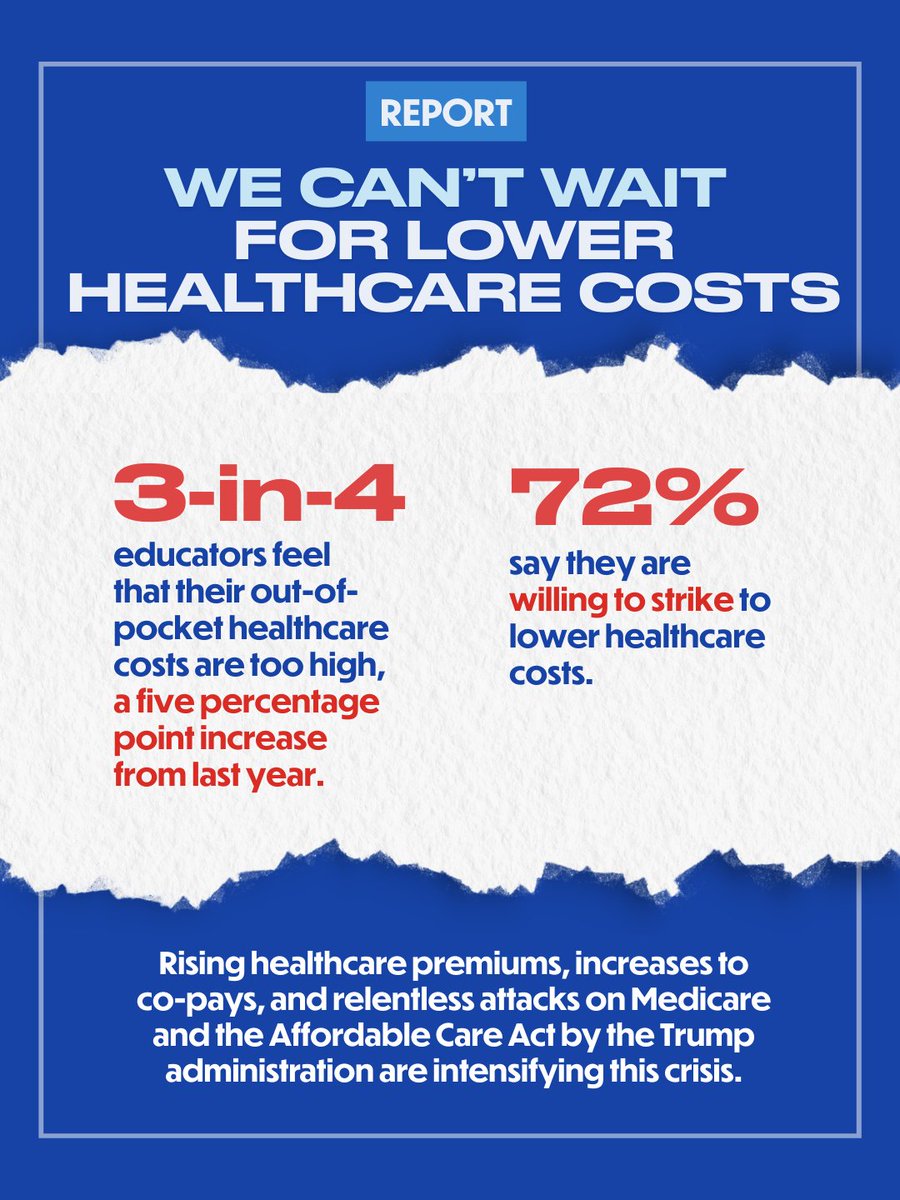
In the beginning of March, three Sacramento-area locals stepped up their fight for health care, with TRUE and NTA going on strike and WSTA members voting to authorize one.
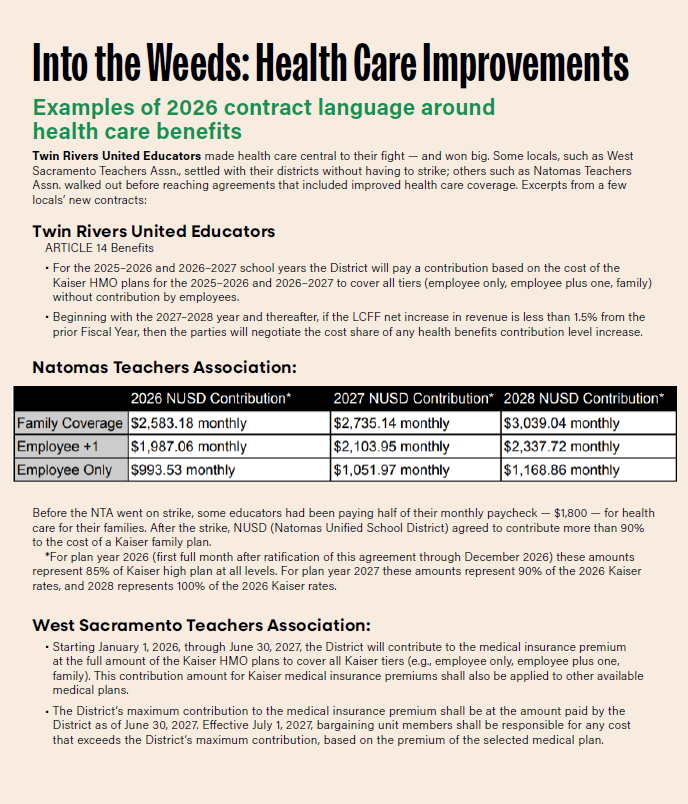
Some Natomas educators had been paying half of their monthly paycheck — $1,800 — for health care for their families with a lot of educators just opting not to take the district’s plan at all, according to NTA President Vaccaro. Their seven-day strike moved the district from 50% to a more than 90% contribution for a Kaiser family plan.
“Winning that shift to almost fully covered health care really sets us up to continue this fight for fully paid health care,” Vaccaro says. “I don’t think people realize how much health care impacts our educators until you see it in real time. Am I going to pay for health care or am I going to pay for groceries? It’s tough.”
Vaccaro says NTA’s fight was powered by strong member engagement and constant, clear communication with all members to ensure everyone understood what they were fighting for and why. He says it was very inspiring to be a part of We Can’t Wait and the statewide movement for the safe, stable and fully staffed schools our students deserve.
“While you see the victories up and down the state, the fight is far from over,” Vaccaro says. “You see the fight to defend Prop. 98, extend Prop 55, and improve public schools for everybody. It’s going to take all of us fighting together to make real change for all of us.”
Striking Natomas Teachers Assn. members, left, and Twin Rivers United Educators members, at right, demand fairness — and paid health care. 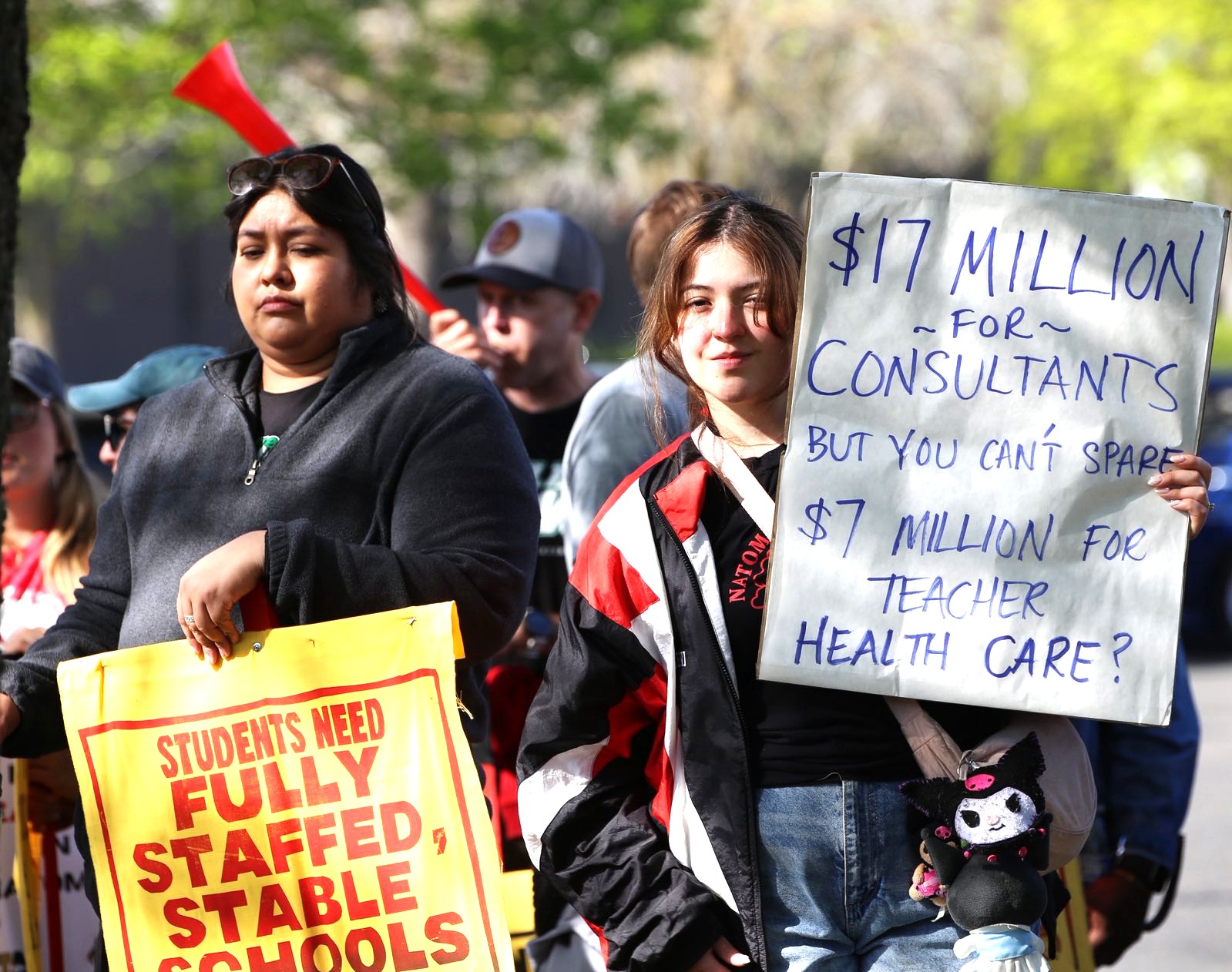

In neighboring Twin Rivers, a hard-cap on district health care contributions meant some TRUE members were paying as much as $1,600 a month for health care for their families — TRUE President Ward says that going into their 12-day strike, they were prepared to hold the line on fully paid health care to stop the ongoing educator retention crisis in Twin Rivers. The district superintendent resigned several weeks before the strike began. But after 13 months of non-existent negotiations and just four days into the strike, Ward says district administrators finally came to the table with an offer of fully paid health care.
“But it had a sunset date, so it would be fully paid for the moment, and we said that’s a non-starter,” Ward says. “It was devastating — at that point, I didn’t even know if we would be able to hold the line but of course, we did.”
On the eve of what would have been Day 13 of their strike, the two sides reached a compromise: fully paid Kaiser for educators and their families with no sunset, retroactive to the beginning of the school year. While it was a tough decision to let go of other parts of their proposal, Ward says it was worth it.
“We saw members getting thousands of dollars back. I got emails and calls from crying members,” Ward says. “A lot of our members couldn’t afford to take health care and now they can, which is going to make a huge difference. Our open enrollment meetings have been packed with interested folks.”
Ward says TRUE’s historic victory was powered by members who were committed to each other for better, explaining that they had prepared for the moment with a comprehensive site visit program, expanded bargaining team, regular communication and nuts-and-bolts structure building. Together, they showed that educators united with community are unstoppable, even against a seemingly immovable school board dead-set on breaking the union.
In West Sacramento, WSTA members were ready to join NTA and TRUE on the picket lines, with members voting near unanimously to authorize a strike and negotiations slowing to a halt at the bargaining table. Meanwhile, WSTA members were struggling with exorbitant health care costs, with some educators paying more than $1,700 a month for family coverage. While WSTA worked to educate the community about the issue, the school district and board seemed unconcerned — until they were, coming to an agreement before a strike that provides fully paid Kaiser health care retroactive to January.
“Winning fully paid health care had a transformational effect on our members. People were paying $1,700 a month for health care and now have that money to put into their families, buy food and have a standard of living that wasn’t available to them before,” WSTA President Knepp says. “Our new teachers were making $58,000 a year and health care was costing them $17,500 — health care was putting them under the poverty line. It’s life-changing not to have to choose between burgers and band practice for your kids.”
Knepp credited the sudden movement on health care and agreement to the then-ongoing struggles in Natomas and Twin Rivers and the acknowledgement that indeed WSTA members were ready to join them to fight for what West Sacramento students and educators deserved. Ironically, WSTA didn’t initially include fully paid health care in their proposal, adding it when Gov. Gavin Newsom announced there would be more public education funding than expected. Knepp said it was a risk, but they decided it was worth it.
“In the end, everyone deserves to be appropriately taken care of in their work,” says Knepp. “All we’re asking for is to be compensated enough to take care of our families.”
Small Locals, Big Fights, Inspiring Wins
The Santa Cruz area is the most expensive place to live in America, which compounded matters when Soquel Education Association (SEA) members saw their health care costs jump by as much as 70% from one school year to the next due to a hard cap that sets the district’s health care contribution and forces educators to bear the burden of all increases. SEA President D-R. Martin says her insurance was set to increase from $575 to $940 a month, even with reduced coverage, a higher deductible and more expensive prescription costs.
“Some families are paying $2,200 a month out of pocket and others have $10,000 deductibles to pay less monthly,” Martin says. “Our thinking before was if we increased our salary structure, we could apply extra income to health care costs but we didn’t expect it to be so out of control like this.”
With members suffering, SEA asked for a $200 increase to their hard cap earlier this year — district admin responded with an offer of one-third of that and no salary increase. SEA members organized, rallying at board meetings and building a movement with their parents and community to keep SEA educators in Soquel — eventually winning a 3% salary increase, a cost-of-living increase next year, a one-time bonus of $2,500 and the $200 increase to the health care cap. With health care costs anticipated to continue increasing, Martin says something must be done to stop Soquel’s educator retention crisis.
“When we did a survey in (the) fall, 47% said they were actively looking for other jobs, and we’ve lost a couple people already this year,” Martin says. “I hope that we can put a spotlight on the importance of health care. We’re less than 100 members and I hope that other small locals look at what we’ve done and say ‘if they can put up a fight, so can we.’
You can organize even if you’re small — the organizing never stops and you build connections with your community and other unions. This is a big key to our success.”
Below: LLEA members, as well as parents and community, called for improved health care benefits.
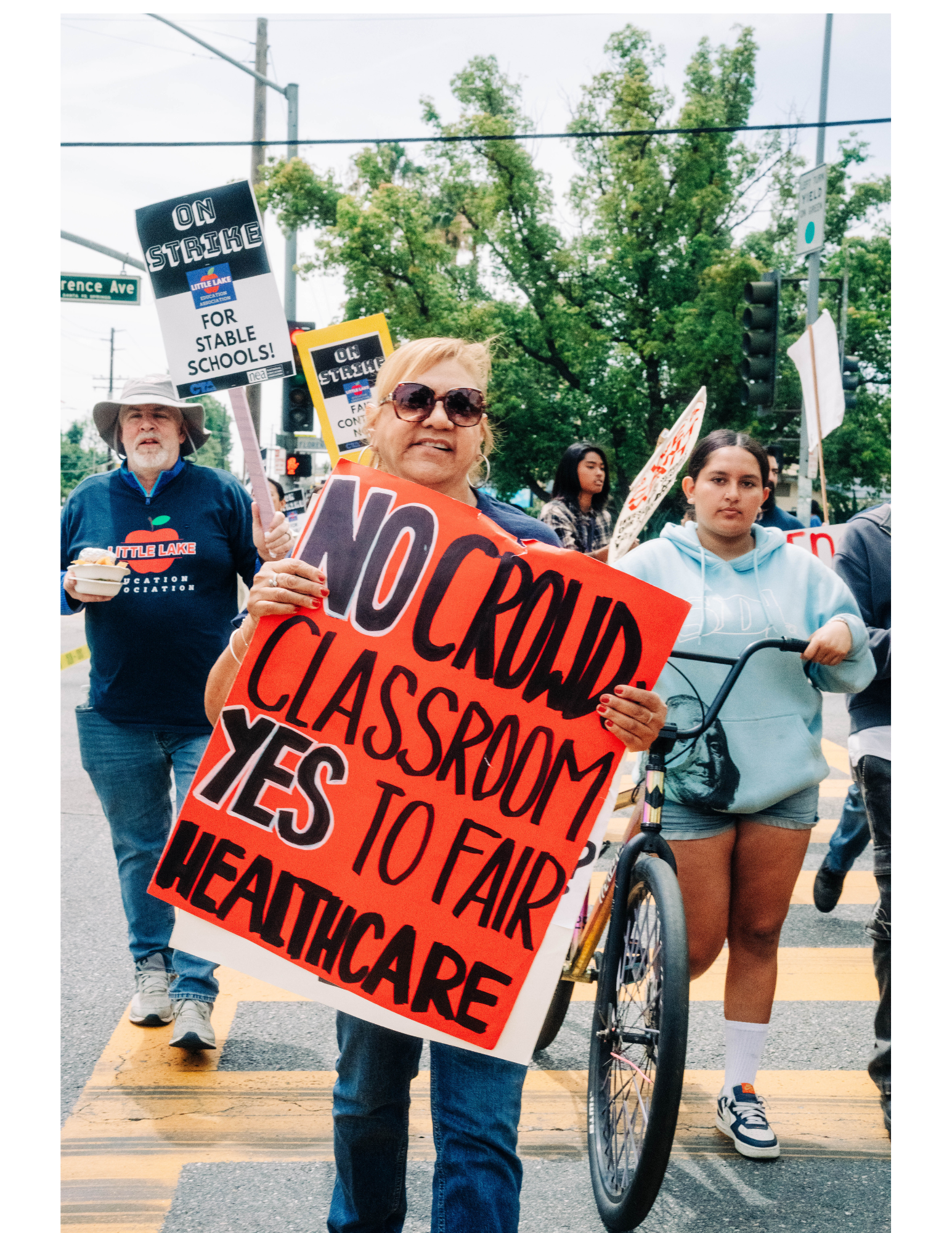
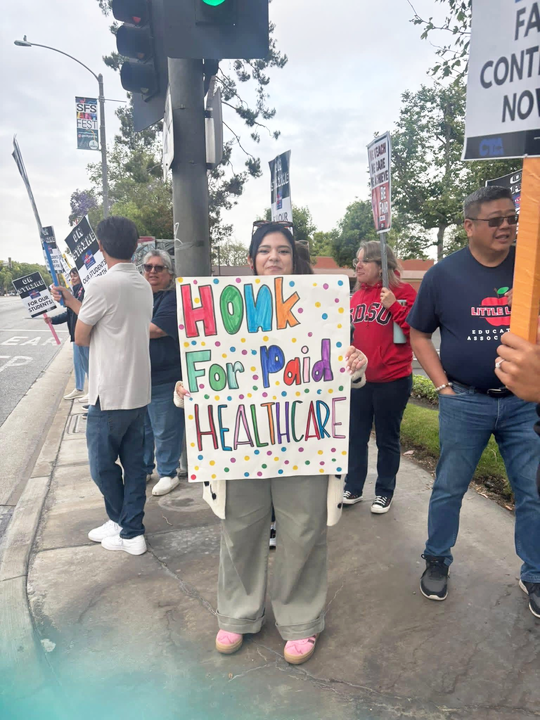
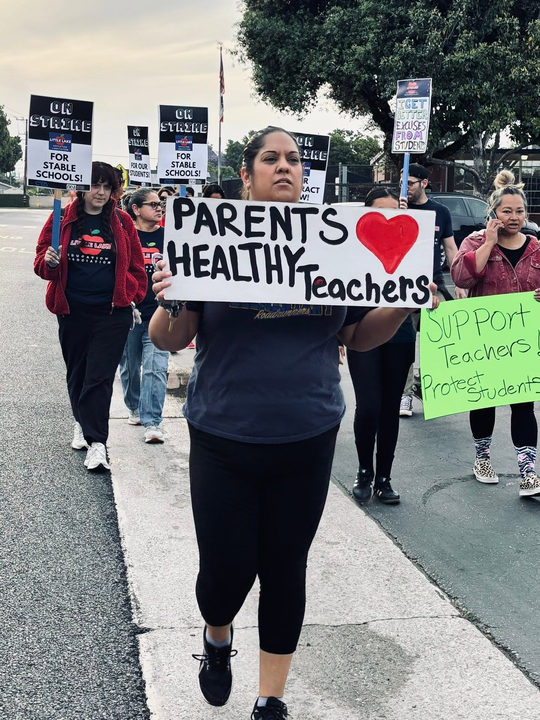
In Santa Fe Springs and Norwalk, the 200 members of Little Lake Education Association (LLEA) found themselves facing massive out-of-pocket cost increases after a new superintendent refused to honor past memorandums of understandings, reverting back to old contract language and imposing a mid-year and massive increase for out-of-pocket health care costs for employees. Many educators were facing monthly costs of $1,400 and some even potentially paying a shocking $2,600 a month, causing LLEA members to escalate their organizing and fight back. District administration agreed to offer more toward health care, but at the cost of increasing class sizes — a trade educators were unwilling to make.
“Every offer they gave us included throwing the kids under the bus, and we weren’t not going to do that. We were not going to treat our students as pawns,” says LLEA President Maria Pilios. “Our school board dug in and told LLEA that the community would stand with the district, so we said ‘ok, let’s find out.’”
After an historic and inspiring 10 days on picket lines, LLEA educators had organized their community, captivated the hearts of the Los Angeles metropolitan area and inspired hundreds of thousands of members across CTA — and the superintendent and a school board member had resigned. LLEA won improvements to their health care benefits and immediate relief for educators — all without sacrificing class sizes to maintain student learning conditions.
“We’re at a good foothold and we’re looking forward to making even better strides in the next contract,” Pilios says. “The biggest things we got out of this is we learned how to stand up for ourselves, how to say no when we are being treated unfairly and finding out our parents love us as much as we love their children. We found our voice as a union.”
The Discussion 0 comments Post a Comment